China Energy Investment Corp. pledged almost $84 billion in shale gas and chemical manufacturing projects across West Virginia after President Donald Trump’s trade mission to Beijing in November, but when it came time to discuss details officials were a no-show. The chief executive and other officers of the world’s largest power company canceled a visit to a petrochemical conference in Pittsburgh, where the projects were to be discussed, casting doubt on their fate amid an escalating trade war between the U.S. and China. “In light of the ongoing dispute between the U.S. and China on trade, the China Energy team decided right now is not the right time for them to come and visit,” said Brian Anderson, director of the West Virginia University Energy Institute, an arm of the school that recently signed an memorandum of understanding to work collaboratively with China energy on research and training programs.
General Motors warned Friday that new auto tariffs would undermine its ability to compete. Shares of the US's largest automaker fell 2% after the comments were filed. "At some point, this tariff impact will be felt by customers," the company said in a filing with the US Commerce Department. Follow GM's stock price in real-time here.
President Donald Trump reportedly wants to yank the US out of the World Trade Organization, a move that would upend the decades-old international trading order. Jonathan Swan at the news website Axios cited an anonymous source Friday as saying Trump had repeatedly asked his advisers about pulling the US out of the WTO and had said the rest of the world used the organization to "screw the United States."
President Trump on Sunday refused to back down on his administration’s tariffs against U.S. allies, arguing that the European Union is “as bad as China” in its trade policies. Trump appeared on Fox News’s “Sunday Morning Futures,” where host Maria Bartiromo asked if he’d considered teaming up with U.S. allies to combat China’s trade policies. “The European Union is possibly as bad as China, just smaller. It’s terrible what they do to us,” Trump said. “I love those countries, Germany, and all of the countries. Scotland. ... But they treat us very badly. They treat us very unfairly,” he added, noting that "my parents were born in the European Union." Trump's mother was born in the United Kingdom, while his father was born in New York City. Trump continued to rail against American trade deficits with other countries, arguing that each of those nations should be subject to tariffs, regardless of broader alliances.
Canada announced Sunday that it has moved forward with retaliatory measures against U.S. steel and aluminum tariffs, slapping $13 billion in its own tariffs on American exports. CNN reported that over 40 U.S. steel products will see tariffs of 25 percent. A 10 percent tariff will be levied on more than 80 other American items, including toffee, maple syrup and coffee beans. The tariffs come amid an escalating feud between Canada and the U.S. over trade policy, after President Trump imposed steep steel and aluminum tariffs last month on Canada and other longtime U.S. allies.
Anna Zhou and Ethan Harris, economists at Bank of America Merrill Lynch, say Trump's tariffs and focus on the bilateral trade deficit echo similar policies undertaken in the 1980s— especially when it came to Japan. Even on the surface, the parallels are apparent: A Republican president undertakes a series of protectionist trade actions against a close US ally in hopes of reducing a growing US trade deficit and protecting specific US industries. "In the 1980s, like today, the large deficit was seen as prima facie evidence of unfair trade," Harris and Zhou said. "The US responded with claims of unfair trade and implemented a long string of protectionism measures, particularly targeting Japan.".. The end result of the 1980s-era policy was an inability to slow the growth in the US trade deficit. According to the BAML economists, the deficit widened from $36 billion, or 1.3% of GDP, in 1980 to $170 billion, or 3.7% of GDP, in 1989. Zhou and Harris say there were a few main lessons to glean from that period that are relevant today
Citi's weekly European economics note, compiled by a team led by Christian Schulz, argues that rising tariffs put in place by the Trump administration could allow European corporates to gain a competitive advantage over their American counterparts. "Winning the trade war, albeit not from the sidelines anymore, remains a real opportunity for Europe," the team wrote to clients late last week. The team's thesis centers on two arguments. First, the belief that while tariffs will hurt the businesses of European companies in the US, it will allow them to compete more aggressively with American firms in markets like China. Second, that the US will damage its international reputation, allowing the EU to become the global trading partner of choice for major economies. "European companies compete with US firms in key markets such as China and could win market share at the expense of their American counterparts," Citi's analysts wrote.
Following the close of a second quarter that will be best remembered by President Trump's vacillations on trade, Axios has dropped a Sunday night bombshell that may spook markets hoping for a respite from the daily escalating trade war rhetoric as the second half of the year begins: White House reporter Jonathan Swan has obtained a copy of a draft bill, purportedly ordered by Trump himself, that would allow the US to "walk away" from its commitments to the World Trade Organization. If passed, the bill (entitled the "United States Fair and Reciprocal Tariff Act") would effectively blow up the WTO, an organization that the US helped create back in the 90s, by allowing Trump to unilaterally ignore the two most important principles: The "Most Favored Nation" (MFN) principle that countries can't set different tariff rates for different countries outside of free trade agreements; "Bound tariff rates" — the tariff ceilings that each WTO country has already agreed to in previous negotiations. "It would be the equivalent of walking away from the WTO and our commitments there without us actually notifying our withdrawal," one anonymous source reportedly told Axios. The bill asks Congress to hand over to Trump unilateral power to ignore WTO rules and negotiate unilateral trade agreements. The leak of the draft bill follows another WTO-related scoop from Axios, published last week, where Swan reported that Trump has repeatedly badgered his aides about pulling the US out of the WTO, which the president has famously criticized as a "disaster".
The state of Alabama is seeing delays in big manufacturing investments in light of President Donald Trump’s bellicose trade policies and is urging a more conciliatory approach. “We’ve seen a couple of projects that we’ve been actively working where their timeline has slipped,” Greg Canfield, the state’s secretary of commerce, said in an interview. “The longer this drags out, the more danger there is that we’ll see a real drag on our economy. We’re going to see Alabama lose jobs, and that’s not acceptable.” For the past two decades, Canfield’s state has been a standout when it comes to luring car factories. Alabama gave more than $100 million in incentives to Daimler AG to attract its first assembly plant, which started making Mercedes-Benz vehicles in 1997. Now it has 57,000 autoworkers building about a million cars and light trucks a year. It’s the third-largest state for U.S. auto exports, and landed one of last year’s biggest industrial prizes: the $1.6 billion factory Toyota Motor Corp. and Mazda Motor Corp. chose to build in Huntsville.
And what’s especially striking right now is that even industries Trump claims he wants to help are protesting his policies, urging him to reverse course. General Motors warns that proposed auto tariffs could lead to “less investment, fewer jobs and lower wages for our employees.” The Motor & Equipment Manufacturers Association has urged the administration to stand down, declaring that “counterproductive unilateral actions” will “erode U.S. jobs and growth” while doing nothing to protect national security. What do these industries understand that Trump and Company don’t? That international economics isn’t a game in which whoever runs trade surpluses wins, and that disrupting global supply chains can hurt almost everyone.
Commerce Secretary Wilbur Ross told CNBC on Monday that there's no level on the downside in the stock market that would alter the way President Donald Trump approaches trade. "There's no bright line level of the stock market that's going to change policy," Ross said on "Squawk Box." "The president is trying to fix long-term problems that should have been fixed a long time ago."
Donald Trump said his administration’s tariffs on imports would create U.S. jobs. But the list of companies blaming the tariffs for job losses—or expressing concern about future cuts—is growing:
This report cites state-sponsored cyber-theft, Chinese acquisitions of sensitive and strategically important U.S. technology companies and restrictions on non-Chinese investment in China, to forcibly transfer technology into Chinese hands. These are serious and credible allegations. But the justifications for taking action against China include less serious allegations as well. The White House Office of Trade and Manufacturing Policy issued a second report in June aiming to bolster the justification for economic hostility toward China. This second report reiterates the conclusions of the USTR’s report, along with some astonishing additional allegations:
The European Union is reportedly ready to hold talks with major car manufacturers about a coordinated effort to cut preexisting tariffs as a means of defusing President Donald Trump's trade war before it escalates further. According to a report in the Financial Times, senior EU officials are drawing up plans to discuss a deal between major car exporters including Japan, South Korea, and the US to cut tariffs on their movement globally. This would be an attempt to address Trump's belief that the US is unfairly punished in the global car trade. It would also reduce "export costs for other participating countries' auto sectors," the FT reports. The European Commission has not confirmed the plans, saying its president, Jean-Claude Juncker, "has not yet decided what to discuss" at a meeting with Trump set to take place in the coming weeks.
5G plays a big role in the trade war between the US and China:
Even America's closest allies have realized the threat China poses in the technology space. Britain's Foreign Minister Boris Johnson said at a recent event that Chinese technology firms could overtake the U.S. "The Chinese are about to win. They’ve got 5G. They’ve found out a way. Everybody’s going to be getting stuff on their gizmos through the Chinese system and not the American system," Johnson said, according to The Guardian newspaper.
China’s Belt and Road Initiative aims to build trade infrastructure and expand Beijing’s global influence. As the U.S. turns increasingly protectionist, disrupted supply chains could send countries moving closer to China. Still, China’s globe-spanning project has faced problems, including debt overload and political risks.
Red states, so-called because they're historically Republican or voted for Trump in 2016, stand to lose more because they benefit the most from trade with other countries, Citi's Peterson said. Imports and exports to red states totaled $2.1 trillion last year, compared to $1.7 trillion for Democratic blue states. Texas, Michigan, and Illinois were among the largest contributors to trade nationwide, since they have some of the largest ports. After examining the kinds of goods that could be taxed, Citi found that red states ship more to countries that could retaliate US tariffs. These exports include various kinds of food, beverages, luxury goods and medical appliances — all of which are under the purview of tariffs.
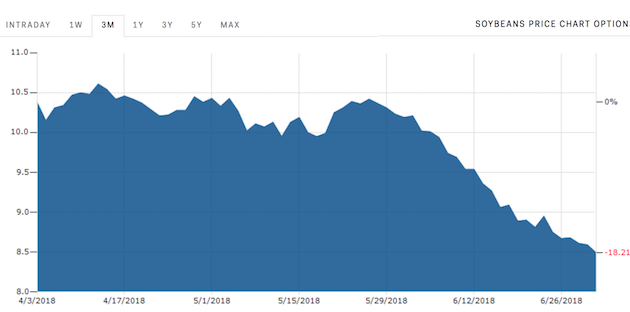
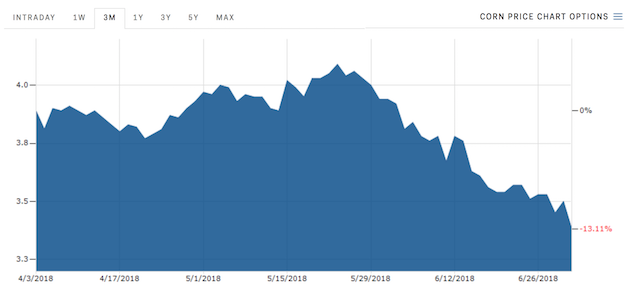
For farmers who produce the United States’ two biggest crops, corn and soybeans, the actual imposition of these long-threatened tariffs is a formality—look at what’s been happening to prices recently. Here are soybeans:
The current slide comes at a precipitous time for US farmers. They have about 179 million acres of the two crops growing in their fields—a combined land mass equal to nearly two Californias, and just 1 percent less than last year’s plantings. To make a profit on these crops, farmers will have to make at least $4 per bushel on corn and $10.05 on soybeans for the 2018 harvest, a University of Illinois analysis found. Currently, the two commodities fetch $3.43 and $8.40, respectively.
Meanwhile, vast portions of last years’ bumper harvest remain unsold. Soybean farmers churned out a record 4.39 billion bushels in 2017—and more than a quarter of the harvest is still sitting in grain bins waiting for a buyer, according to figures recently released by the US Department of Agriculture. Meanwhile, farmers and grain elevators had to stockpile 5.31 billion bushels of corn, more than a third of last year’s harvest.
Chad Bown and colleagues have a remarkable chart showing the distribution of the Trump China tariffs: an amazing 95 percent are either on intermediate goods or on capital goods like machinery that are also used in domestic production
For those who observe that the economic and financial fallout from US President Donald Trump’s trade war has been surprisingly small, the best response is that a lagged effect is exactly what we should expect. Just wait.
But amid the flurry and sudden rush of trade protectionism, Trump's goal in the end remains a mystery. "The honest answer is that no one knows," Edward Alden, a senior fellow at the Council on Foreign Relations, told Business Insider when asked Trump's end game. "There appear to be real differences within the administration, and the president has not made his positions clear." Trade experts say the lack of a clear objective from Trump risks extending current trade fights indefinitely and causing major harm to the US economy.
That last point from Morgan Stanley (that a major escalation in trade tensions would spill over and threaten to derail economic momentum in the U.S.) is the subject of vociferous debate. Notably, Goldman doesn't agree, writing the following in a new note: Historically the US has been fairly immune to foreign spillovers. According to our analysis of the historical causes of US recessions, it has been about a century since the US last ‘imported’ a recession via weak global demand or financial contagion. That said, the bank does caution that thanks to the interconnectedness of global markets, the risk of financial contagion (e.g., turmoil in global equity markets spilling over into U.S. stocks) is now greater than ever.