
+- ShareholdersUnite Forums (http://shareholdersunite.com/mybb)
+-- Forum: Companies (http://shareholdersunite.com/mybb/forumdisplay.php?fid=1)
+--- Forum: Pareteum (TEUM) (http://shareholdersunite.com/mybb/forumdisplay.php?fid=61)
+--- Thread: Business model (/showthread.php?tid=12373)
Business model - admin - 03-24-2019
Here a thread to discuss Pareteum's business model. We'll start off with an introduction from Chairman Hal Turner from the June 2017 Letter to Shareholders:
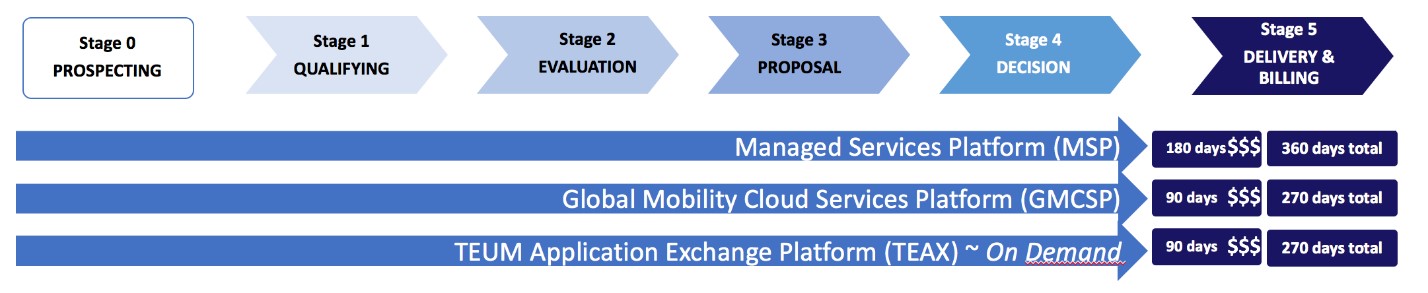
In our business, we have three subscription-based offerings:
(1) the Managed Services Platform (i.e., serving customers such as Vodafone, Zain and the new customer in Brazil);
(2) the Global Mobility Cloud Services Platform (i.e., serving customers such as THYNGS); and,
(3) the App Exchange and Development Platform (i.e., serving customers such as Pronto Telecom)
For GAAP accounting purposes, revenue is earned when services are delivered, regardless of when cash is received. Therefore, it’s critical to understand the timing involved in the various steps of our business – the signing of an agreement; the implementation and delivery when service is established, and finally, billing which generates revenue. This is a multi-stage process that typically takes 90 days to complete and up to six months or more for very large Managed Services implementations as illustrated below:
Furthermore, in terms of inherent value and market multiples, these contracts also include a variety of customer commitments which generate a backlog of stable, predictable and guaranteed revenue for the Company. As of today, our contracted backlog currently stands at approximately $60 million, however, with a capitalization that is just 1/10th of our contracted backlog, it’s clear that our Company is not being fully valued by the market. This a disconnect that must and will change, as we begin to deliver the sequential revenue growth we expect to report over the remainder of 2017 and throughout 2018.
Total Contract Value is Only Part of the Story
In our MVNE model, the total contract value (TCV) is one way to measure a SaaS contract under GAAP. TCV is simply the sum of two elements – the upfront service implementation fee and the guaranteed minimum monthly recurring fees from managing individual devices. This, however, is only part of the story as our contracts contain additional important structures which can and do create significant “layers” of revenue for the Company.
Utilizing our Brazilian contract as an example, let me now answer some of the questions on our process from contract award to billing:
- Our Company has been contracted for a seven-year MVNE services agreement. This agreement includes a service establishment fee valued at approximately $300,000 which is used to offset upfront costs including any hardware, software or service provisioning that may be required. This fee is recognized over the course of the implementation period which can take between three and six months based on the customer.
- The terms of this agreement also include a guaranteed “monthly minimum” flat rate fee which is recorded as MRR until the agreed per subscriber/device monthly support charges exceed specified levels. This layer of revenue is called the “ramping period” of the contract and begins immediately upon the onboarding of the first subscriber or device.
- Beyond the calculated TCV, the revenue potential of the Brazilian deal is also impacted by a “protective” scaled per subscriber/device fee schedule. This schedule includes pre-defined fee increases should the customer not reach their own projections. This is one of the contractual elements present in each of our MVNE services contracts that generates the sizable backlog I referenced earlier.
While newer contracts like Brazil reflects the general base structure of our MVNE SaaS contracts, it is important to note that established customers such as Vodafone have already surpassed their contract minimums, meaning they are generating MRR which we call “run rate revenue” and are contributing to our backlog. This contracted backlog has value not only because of its present value, but because of its stability and predictably as defined by a tiered per subscriber/device fee schedule.
To recap, there are four key drivers of revenue:
1) Upfront service establishment fees,
2) guaranteed minimum monthly recurring revenue (recorded as MRR),
3) an estimated scaled subscriber/device fee schedule based upon customer-provided estimates, and,
4) current MRR/run rate revenue generated from existing customers which today is our primary base of revenue. Each of these key revenue drivers has its own time frame for revenue recognition.
RE: Business model - admin - 03-24-2019
And here you find useful info about one of their (three) platforms, its Global Mobility Cloud Platform (from company PR):
NEW YORK, May 24, 2017 – Pareteum Corporation (NYSE MKT: TEUM), (“Pareteum” or the “Company”), a leading international provider of mobile networking software and services to the Mobile Network and Internet of Things markets, today announced that it has been awarded a new cloud services contract by a UK-based Communications Service Provider (CSP) under which it will provide on-demand hosted Home Location Register (HLR) services. The new CSP customer intends to utilize the subscriber database management and billing capabilities of the Company’s Global Mobility Cloud Platform to manage its end users’ mobile devices. The service will be established in the third quarter with the expectation of transaction-based revenue to commence during the fourth quarter.
The main database location of permanent subscriber information for a mobile network is the Home Location Register, or HLR. This database contains pertinent user information such as address, account status, and preferences and is searched each time any mobile connection is attempted, usually through the carrier initiating the call or through one of a number of authorized database service providers who generate revenue on a per-lookup fee. With the advent of mobile devices that allow users to switch services, especially when roaming, subscriber control and management can become difficult and expensive as millions of devices attempt to establish millions of network connections each day. By moving the Home Location Register and subscriber database management into the cloud, delivered in a Software-as-a-Service model through Pareteum’s Global Mobility Cloud Platform, CSPs can cost-effectively manage growing numbers of mobile devices, including network metering and billing, without a large upfront investment in infrastructure hardware and with lower, “pay as you go” transaction costs.
“Our Global Mobility Cloud continues to demonstrate its ability to disrupt the traditional model of mobile communications service delivery. With today’s contract award, we are creating an entirely new capability that can further transform the industry,” said Hal Turner, Executive Chairman of Pareteum. “As adoption of mobile communications accelerates, driven by new IoT services, billions of connected devices are set to come on line, bringing virally spiraling amounts of data that require metering, charging, billing and reporting, all critical capabilities inherent in our Software-as-a-Service offerings. We firmly believe that the need for our flexible infrastructure platforms will dramatically expand, and, we are confident that Pareteum’s technology will further prove that it is well positioned to meet the industry’s evolving needs.”
The new service offering is enabled through the Company’s patented “SIM-free HLR Migration” technology which allows any Mobile Network Operator (MNO), Mobile Virtual Network Operator (MVNO) or CSPs to seamlessly migrate a subscriber from one central subscriber database to another, without requiring the issuing of a new SIM (Subscriber Identity Module) to end users. Another key benefit of the SIM-Free HLR Migration technology is its critical ability to authenticate a mobile device when it accesses an operators’ network since all devices accessing a mobile network are required to provide its subscriber identifier which allows the carrier’s Home Location Register to authenticate it each time it connects to the mobile communication network. With the SIM-Free HLR technology, the subscribers’ individual security-code is fully-secured and embedded to eliminate any potential data access risks.
Vic Bozzo, Chief Executive Officer of Pareteum, added, “Today, Home Location Register services represent a multi-billion dollar a year industry for providers around the world who generate fees based upon millions and millions of look-up transactions. Because our Global Mobility Cloud platform already enables customers to cost effectively outsource all of their subscriber management functionality, it is ideally suited to support high-transaction volume services such as HLR-as-a-Service. With this new customer, we intend to leverage our Intellectual Property and the core capabilities of our cloud platform to tap into new sources of revenue.”
RE: Business model - admin - 03-27-2019
MVNO stands for Mobile Virtual Network Operator, that is, companies offering mobile services without actually owning any infrastructure. That was going to be the future, but there were a few snags to iron out, as Bart Weijermans from Pareteum (and formerly Artilium) explains in the article:
Quote:When the MVNO model first appeared, it was predicted that a wave of non-telecom B2C brands would seize the opportunity to diversify into mobile. With a few high-profile exceptions, the wave never came. The challenges were significant, not least dependency on an often-inflexible relationship host network, and the complexity involved in building and managing the systems needed to make the service work. In 2019, things have changed. I believe we may be on the cusp of new momentum in MVNO innovation, as sophisticated cloud platforms make it easier for brands to enter the market.The evolution of the MVNO: Why now is the time for brands to take control - Telecom Tech News
Amid the barrage of press releases issued during MWC Barcelona this year was a quiet announcement from Sprint and Google, which reported that the US operator will supply 5G connectivity for the Google Fi MVNO when it launches the new technology in key U.S. cities sometime during the first half of this year. As 5G announcements go this one ranked among the less bombastic, particularly for an MWC week. But you don’t have to be making all the noise to be saying the most important things.
See the rest of the article. Google Fi is likely to be the next big MVNO, but the barriers to entry have been greatly lowered by CPaaS platforms like Pareteum offers.
Upending the playing field with new services:
Quote:Many operators, for whom network and service are one and the same, probably still bristle at this idea. After all, the customer relationship is owned by a non-telecom brand delivering a fully virtualised communications service which is entirely distinct from (and not even dependent on) a single network. A brand which has been steadily introducing and integrating new high-value services; eSIM, same-cost data roaming in 170 countries, bill protection, spam protection, and VPN among them.The evolution of the MVNO: Why now is the time for brands to take control - Telecom Tech News