+- ShareholdersUnite Forums (http://shareholdersunite.com/mybb)
+-- Forum: Alternative Energy Stocks (http://shareholdersunite.com/mybb/forumdisplay.php?fid=52)
+--- Forum: Alternative Energy News (http://shareholdersunite.com/mybb/forumdisplay.php?fid=11)
+--- Thread: The coming solar singularity (/showthread.php?tid=8266)
“It’s tough to make predictions, especially about the future,” quipped Yogi Berra. I keep his wise admonition in mind as I make predictions about our energy future, but we have many reasons for optimism when it comes to the future growth of solar.
Here’s the summary: solar is taking over. We can now see many years into the future when it comes to energy. And that future is primarily solar-powered.
Why am I so optimistic about solar's prospects? Well, let me explain.
The “solar singularity” will, by my definition, occur when solar prices become so cheap that solar becomes the default power source based on cost alone. We aren’t there yet, but we’re probably just a few years away from that point, particularly since energy storage costs are already declining strongly. (I’m not going to address storage in this article further, but, of course, a grid can’t run on variable solar power alone, so we’ll need storage and other backup technologies to ensure reliable grids as solar power penetration grows.)
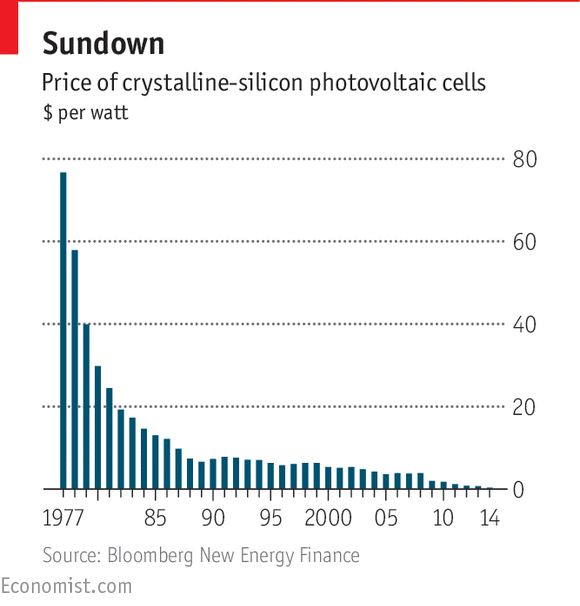
Swanson's law, named after the founder of SunPower, states that the price of solar panels generally drops by 20 percent with every doubling of shipped panels. This has been the general trend since solar became a viable technology -- hence its designation as a “law,” even though there are times when some deviations from the trend take place. For example, from the mid-1990s until 2008, solar costs declined by relatively little, primarily due to stubbornly high silicon prices against a backdrop of increasing commodity prices across many markets, until the crash of 2008. Since 2008, however, panel cost declines have accelerated, and the general trend has returned with a vengeance.
Figure 1: Swanson’s Law Says Solar Panel Prices Decline 20 Percent With Every Doubling of Shipped Panels
Source: Wikipedia
When we compare recent cost declines for solar to other energy prices, we get a pretty picture indeed, and this is why solar is now getting very serious attention from investors and pundits alike.
Figure 2: Comparing Solar Panel Price Declines With Those of Other Types of Energy
Source: Bloomberg
Swanson provided some interesting additional insights into the nature of his eponymous law in a 2014 email in response to an earlier article of mine:
[“Swanson’s law”] is not really a “law” but merely expresses the fact that manufactured goods tend to follow a straight line on a log-log plot of price versus cumulative unit volume. To the best of my knowledge, no one knows why this is so. It is curious that it usually continues to be so, even when the costs become largely commodity items like glass and steel. This has led some in the past to assume that the cost reductions would flatten out when commodity material costs dominate. In fact, this has not been observed, in part because people find ways to use less materials, and because materials themselves follow a learning curve
REN21, a nonprofit organization, releases an annual report on the global status of renewable energy. Its 2014 report showed a phenomenal 39 percent growth in solar power, with 39 gigawatts added. REN21 hasn’t released its figures for 2014 yet, but we can expect similar figures for 2014 to those we saw in 2013. It must be satisfying for Swanson to see his predictions come true in spades. When he wrote his 2006 paper, global solar installations totaled only about 5 gigawatts. We are now, in early 2015, at almost 200 gigawatts, about 40 times the installations in 2006, with prices declining much as he predicted.
Figure 3: Global Solar Power Growth Through 2013
Source: REN21
Total U.S. installations now stand at about 20 gigawatts, or 10 percent of the total and enough power for about 4 million U.S. homes.
What about subsidies?
Subsidies have been a big part of getting solar to where it is today, but subsidies are becoming increasingly unnecessary as solar prices plummet. California’s residential and commercial solar rebate program (the California Solar Initiative, or CSI) is all but gone as the rebates have been used up, yet California’s retail solar market is still growing strongly.
On the wholesale side, the federal 30 percent Investment Tax Credit (ITC) is set to decline to 10 percent at the beginning of 2017. The conventional wisdom is that we’ll see a big drop in installations when this happens. However, a silver lining to the Republican-controlled Congress and their antipathy to green power is that there is little hope at this point that the 30 percent ITC will be extended.
This means, contrary to the similar discussion with respect to wind power’s tax credits over the last decade (they’ve expired a number of times, leading to a slowdown in installations for a year and then a rebound when the credit is renewed), there won’t be a slowdown in anticipation of an eventual renewal of the tax credit. We should see solar companies simply adjust to the lower tax benefit and keep on trucking.
SunPower, a major player in today’s markets, is already predicting little impact from the reduced ITC, based on the ability to develop profitable projects even with the reduced ITC of 10 percent.
James Smith, an investment analyst at Catapult Research, recently issued a very bullish report on solar, providing some good corroboration of my predictions here. He stated in his report, excerpted here: “I’m saying that if the cost of solar drops 20 percent in price every time the installed base doubles, it is only a matter of time before solar takes over from fossil fuels. My best guess is that it starts to really happen from 2017 onward.”
Is the past a reliable guide to the future?
Making predictions (especially about the future) is difficult, because there is no guarantee, of course, that the past is a reliable guide to the future. However, when it comes to solar power, we see the very clear trend of price reductions continuing for some time, because there are no inherent limits to further reductions. Jeremy Rifkin has made the case that solar panels will become practically free with zero marginal cost for production in his book The Zero Marginal Cost Society. As we’ll see below, this is a reasonable prediction.
Solar panels are not the only cost component for solar systems, and they are increasingly becoming a minor cost because of ongoing panel cost reductions. The main components of overall costs are now soft costs like labor and the “balance-of-system” costs for equipment like inverters, racks and wiring. However, these other costs are also declining substantially, and groups like GTM Research predict further major cost reductions.
The basis for my predictions is, however, quite simple: we have reached the point where low costs are driving installations higher, which in turn drives costs lower, which in turn drives installations higher. The virtuous circle seems to be locked in and based on history, we can expect further 20 percent cost reductions with each doubling of capacity, with no inherent limit to cost reductions over time.
Under this trend, we can expect by 2020, under a 30 percent global rate of growth, to see total solar costs for utility-scale systems at around $0.84 per watt, based on GTM Research’s projected $1.10 per watt for 2017. By 2025, the cost drops to about $0.54 per watt, and by 2030 it will be a practically free cost of $0.34 per watt. By 2040, we can expect under these trends to see costs at about 14 cents per watt. A 5-kilowatt home-size system would cost only $700.
That counts as free in my book, because that system will provide power for about 25 years at almost no cost above the initial installation cost. Twenty-five years of production for $700 equates to about 2.8 cents per kilowatt-hour. For comparison, the average retail cost of power in California today is about 15 cents per kilowatt-hour, so this future cost of solar power will be less than one-fifth the cost of today’s power. And this analysis leaves out inflation. If we include inflation, the comparison is even more favorable.
What could derail the solar singularity?
While I’m fairly confident in the coming solar singularity, I’d be foolish not to recognize some inherent uncertainties about making such predictions. I’ll discuss a couple of the biggest uncertainties here.
The biggest source of uncertainty is the rate of growth in installations. In my calculations above, I assumed a 30 percent rate of growth, which is reasonable given the far higher rates of growth we’ve seen in recent years (this results in approximately a 2.3-year doubling time). However, it is likely that we’ll see growth rates decline for a variety of reasons. If installations increase at only 20 percent per year, we see about $0.54 per watt by 2030 and 28 cents per watt by 2040. At only 10 percent growth we see about $0.75 per watt by 2030 and $0.56 per watt by 2040. At these price and installation levels, the singularity still arrives, but it’s delayed.
Figure 4. Projected Cost Declines Based on Swanson’s Law (Ignoring Inflation)
Source: Tam Hunt
The second biggest source of uncertainty is the degree to which there are fundamental limitations in how fast power generation fleets can turn over. Most power generation assets are financed (amortized) over the course of many years, and these investments often require long power sales contracts to justify such investments. This means that a lot of the fleet is locked in contractually at any given time. If a ton of solar is installed in any particular grid system, the threat of “stranded costs” -- costs that are at risk of not being recovered due to under-utilization or an early shutdown -- becomes high.
Only time will tell how the stranded-cost issue shakes out in each country, but there is good reason to believe that even if some grids see a slowdown in solar installations because of concerns about stranded costs, or other problems, that other countries will take up the slack and the general global trend of ever-increasing solar will continue apace.
One issue that I don’t think will be a real problem in the next couple of decades is lack of space for new solar. For all practical purposes, the space for installing solar around the world is infinite. We’ll run out of power demand long before we’ll run out of space for solar. As costs plummet for solar, more and more countries will see solar become economically viable, and more and more locations, such as roadways, areas over metro rail lines, etc., will be covered in solar.
In sum, we have some very good reasons to believe that the solar singularity is indeed nigh. What does a world of free or practically free energy look like? That is a topic for another column.
RE: The coming solar singularity - admin - 04-10-2015
Solar Will Triumph by 2018, Breaking The Subsidy Dependence, Says Bernstein
By Tiernan Ray
Bernstein Research’s Michael Parker and colleagues today offer a mammoth (32-page) assessment of the state of the solar energy market, with implications for installers such asElon Musk‘s SolarCity (SCTY), but also technology vendors such as SunPower (SPWR) andFirst Solar (FSLR).
The authors conclude that by 2018, solar will be so much cheaper than fossil fuels that it will blow away current regulatory hurdles.
As Parker and team write, “we start the clock on solar “Independence Day“: the moment (~2018) when solar plus energy storage is cheaper than retail power supply in a number of large markets.”
“At that point,” they continue, “regulatory changes sought by utilities to restrain solar adoption will be ineffective. And the last barrier to solar disrupting energy markets and the power sector will be gone.”
Here’s the infographic the team offers for how solar plus storage will decline by 2018 (click on the image to see it larger):
The key, the authors write, to the 2018 breakthrough, is that the combined cost of solar, plus a means to store it for longer-term usage, will make solar’s cost fall to 24 cents per kilowatt hour, without subsidy, presenting economics that are compelling:
We are not claiming that 100% of energy supply globally will come from solar in 2018 or 2025, or that 100% of current utility customers in Australia will disconnect from the grid in 2018 or that 100% of California utility customers will disconnect in 2020. It is easier to dismiss our position once it is boxed into that corner… but that’s not what we are claiming. Instead, we are saying something less hysterical: solar plus energy storage will be a credible, low-cost alternative in some markets by 2018… without any form of subsidy. That is going to change the way the profit pool in these industries is allocated. Adoption of solar and energy storage technology will accelerate. New business models will emerge to take advantage of the low cost and improved technology. That scale will help lower costs further. The total number of markets where solar and energy storage will be credible, low-cost alternatives to the grid will continue to increase from there. The good companies in the utility sector will embrace the new technologies quickly (like SBC did). The bad ones won’t.
The economics are already showing a compelling decline in the “installed cost” of solar:
With polysilicon now at less than $20/kg, polysilicon contribution has fallen to $0.10/W or less (~$0.06/W on a cost basis). The decline in polysilicon pricing from its elevated levels in 2007-2008 was largely a function of polysilicon being the hardest part of an over-stressed supply chain to produce. The decline in polysilicon prices has only been one source of savings. Non-polysilicon production cost has fallen from ~$1.50/W in 2007 to $0.35/W today among the best-in-class producers. In terms of installation, at the end of 2011, solar panel manufacturers and developers were estimating a utility scale installed cost of between $2.00 and $2.50/W. Today, utility scale projects are being installed at $1.00/W and in developing markets and we believe that true cost is closer to $0.70/W. Inverter plus steel plus labor plus interconnection costs can be as low as $0.25-0.30/W. Rooftop installation in China is as low as $1.10/W.
Key is storage in the form of batteries, writes Parker, citing work by his colleague Mark Newman:
Electronics and Energy Storage analyst Mark Newman estimates that the energy storage would cost ~$15,000. The solar system would cost $20,000. The batteries would enable you to consume 80% of the electricity produced during the day at night. As long as you didn’t do too much laundry when it had been raining for several days in a row, you would never need to buy electricity from the grid again. The cost for this amenity (again in the red zones below) today is roughly $0.30-32/KWh. Unless you are running a diesel generator today, that is not economic. The cost is roughly the same in developed and developing markets. In developing markets, installing is cheaper but financing costs are higher.
What happens when solar gets so cheap is that utilities will have to embrace it, or be in big trouble:
Utilities can ignore the encroachment of SolarCity-style business models into what are traditionally their most attractive residential customers (home-owning, high-credit scoring households) and hope that our forecasts about falling costs and improving technology are wrong. Alternately, utilities can replicate the SolarCity model of “leasing” the rooftop to provide solar and energy storage on a no-money-down basis and effectively disintermediate themselves. We assume distributed solar leasing businesses will start including energy storage as part of their service to address changes in net metering policies, etc. The third choice is to go on the offensive: utilities can look for ways to develop new sources of residential electricity demand. The most obvious opportunity is electric vehicles. We have been suggesting this as inevitable since last November. We have found at least one regional utility executive thinking the same way: Fraser Whineray from Mighty River Power in New Zealand.
Looking at the small picture, Parker and team also offer an update on the current state of the solar market. Last year was a disappointment in terms of the growth of solar, Parker writes, but 2015 is looking brighter:
The weakness in the solar market (we had expected 50GW and a poly price of $25/kg in 2014) was a function of the Chinese distributed generation market growing slower than expected and the German market shrinking more quickly. India was softer than we expected too. Despite the weakness in growth in 2014, 2015 is setting up as a stronger year. China has announced a target of 17.8GW (up ~70% Y/Y). India is targeting 5GW+ per year annually through 2022. If the rest of the world simply holds serve, that’s a ~11GW increase in demand (+~25%). We believe growth could be even stronger. Opportunity in developing markets continues to improve as module, inverter and installation costs fall, conversion efficiency improves and volumes increase.
RE: The coming solar singularity - admin - 04-16-2015
The race for renewable energy has passed a turning point. The world is now adding more capacity for renewable power each year than coal, natural gas, and oil combined. And there's no going back.
The shift occurred in 2013, when the world added 143 gigawatts of renewable electricity capacity, compared with 141 gigawatts in new plants that burn fossil fuels, according to an analysis presented Tuesday at the Bloomberg New Energy Finance annual summit in New York. The shift will continue to accelerate, and by 2030 more than four times as much renewable capacity will be added.
"The electricity system is shifting to clean,'' Michael Liebreich, founder of BNEF, said in his keynote address. "Despite the change in oil and gas prices there is going to be a substantial buildout of renewable energy that is likely to be an order of magnitude larger than the buildout of coal and gas."
The Beginning of the End
Power generation capacity additions (GW)
Bloomberg New Energy Finance
The price of wind and solar power continues to plummet, and is now on par or cheaper than grid electricity in many areas of the world. Solar, the newest major source of energy in the mix, makes up less than 1 percent of the electricity market today but will be the world’s biggest single source by 2050, according to the International Energy Agency.
The question is no longer if the world will transition to cleaner energy, but how long it will take. In the chart below, BNEF forecasts the billions of dollars that need to be invested each year in order to avoid the most severe consequences of climate change, represented by a benchmark increase of more than 2 degrees Celsius.
The blue lines are what's needed, in billions; the red lines show what's actually being spent. Since the financial crisis, funding has fallen well short of the target, according to BNEF.
While the U.S. pats itself on the back for the riches flowing from fracking wells, an upheaval in clean energy is quietly loosening the oil industry's grip on the automotive industry.
Presentations by analysts at Bloomberg New Energy Finance (BNEF) this week pick away at the idea that supply alone is behind the plunge in crude prices to $50 a barrel. The presentation also shows that low-pollution cars are gaining ground, weakening the link between oil and driving.
The result: Future transport is likely to look a lot different than what the major oil companies are fueling now. Instead of biofuels such as ethanol and green diesel making the internal-combustion engine fit into a world with greenhouse gas limits, wholesale new solutions are coming fast. “Where we are is in an age of plenty,” said Michael Liebreich, BNEF's founder. “We have cheap oil, cheap gas, cheap renewables. You do have an abundance of supply in a way you haven't had for decades. We also are in an age of competition.”
Oil Demand Has Flatlined for a Decade
Source: EIA
As the presentations indicate, oil consumption has flatlined for a decade as supplies from all those fracking wells surged. Through the economic boom, the financial crisis, and the recovery now underway, demand peaked in 2004 and has fallen ever since.
Dramatic Improvements in Miles per Gallon Cut Gasoline Demand
Source: US Dept of Transportation NHTSA
Part of what explains dwindling gasoline demand is as dull as it is important: efficiency. “There was a 60 percent increase in efficiency of the U.S. auto fleet in the last 16 years,” Liebreich said. “This is a global phenomenon.” And it's one of the hidden reasons why the London-based research group doesn't expect a quick rebound for crude.
Electric Vehicle Sales Quintupled in Four Years
Source: Bloomberg
Electric vehicles are starting to take off, with global sales of 288,500 units last year, according to BNEF research. While that's just 0.5 percent of all car sales, it's more than five times the number in 2011, and manufacturers are preparing for more. Because ...
Electric Car Battery Costs Are Falling as Fast as Solar Panel Costs
Source: BNEF, Maycock, Battery University, MIT
Costs are plunging in the electric car business as quickly as they did in the solar industry in the last decade. The price of lithium-ion batteries that power most electric cars has fallen 60 percent from 2010 and will keep declining at the same pace, BNEF estimates. That will bring the price of no-pollution cars within striking distance of ones that require gasoline within a decade.
Fuel-Cell Cars Are Moving Out of the Lab and Onto the Street
Source: BNEF
Fuel-cell cars also are moving from the laboratory to the showroom, starting in Japan with models from Toyota Motor Corp. and Honda Motor Co. By 2018, Japan will be the biggest market for fuel-cell vehicles, with 4,200 cars on the road, almost double the figure for the U.S., according to BNEF researcher Claire Curry.
The Biofuel Investment Plunge Is Cutting off Big Oil's Favorite Clean Solution
Source: BNEF
The future is not uniformly bright for clean energy. Investment in biofuels has plunged 90 percent since peaking at $29.8 billion in 2007. Gasoline substitutes made from corn and sugar in the form of ethanol represent about 10 percent of the U.S. fuel supply, but efforts to make an alternative from crops that can't be eaten have stalled. And lower oil costs eat away at the economic rationale for cleaner fuels.
RE: The coming solar singularity - admin - 05-06-2015
The solar energy industry may prove to be a dark horse in the race to provide global energy security. The world has renewed its interest in solar energy investment as it searches for a cleaner and more sustainable alternative to conventional fossil fuels. Countries like China, Germany, the UK, the US, Japan and Canada have already made significant investments in solar power. Who are the other players who are investing big in solar energy? With its own set of limitations such as high installation costs and high plug-in time, are consumers across the world ready to choose solar energy to power their daily lives? Or, are the conventional energy sources still the best bet?
Source: Bloomberg
Cost Matters
The best part about solar energy is that it is abundant and freely available, at least in most parts of the world. However, the high upfront costs of a photo voltaic panel remain a concern for many. Things are changing fast, however, and according to data from SEIA, the cost of an average PV system in the US is declining each year at a rate of 11%. In fact, the average price of a PV panel hasdropped by 63% since the third quarter of 2010.
In a surprising development, even the gulf region has now recognized the changing nature of global energy dynamics and the growing demand for sustainable energy. According to a report for the national bank of Abu Dhabi by the University of Cambridge and PWC: “As Government and utilities are driven to bring new generation capacity on stream, this new reality (Solar energy) presents a significant opportunity to make savings, reduce fuel cost risks, achieve climate ambitions and, at the same time, keep more oil and gas available for export.
The study says that more than half of global investment in new electricity generation is in renewables. As per this report, around $150 billion was invested globally in solar energy generation in 2014 and solar energy is all set to be at grid parity in 80% of the countries in the next two years. These are big numbers. What we get from this study is that even the gulf region, which is traditionally more inclined towards oil and gas production, is slowly and steadily investing in solar energy. Very few are aware that at the end of 2014, Dubai set a new benchmark by showing the world that photovoltaic technologies can be competitive with oil at $10/ barrel and gas at $5 MMBTU.
Solar Power Set To Become Profitable In Japan
According to Thomas Kaberger of the Japan Renewable Energy Foundation, solar energy is all set to replace imported uranium and fossil fuels in Japan as it is set to become profitable by this financial quarter. Japan is among the world’s four largest markets for solar panels. After the Fukushima disaster, the country’s 43 nuclear reactors have been shuttered. Following these crucial developments, Japan has tripled its renewable energy capacity to 25 gigawatts. What is worth noticing here is the fact that solar energy accounts for more than 80% of this capacity.
What Stops Solar Energy?
The process of connecting a PV system to the grid can be time consuming, frustrating and expensive. In some locations in the US, homeowners wait for more than six months to complete this process. This is one of the biggest factors that limit the tremendous potential of solar energy. Intermittency is another area that dampens the impact of this renewable as current modern grids can only cope with around 40 % of renewable input before requiring modifications. But the biggest limitation of solar energy is the lack of proper storage technology.
Energy Storage Attracting Major Investment
Energy storage is a solution that would tackle several issues related to intermittent power generation. As per the report by Cambridge and PWC, Total Energy Ventures (TEC), the venture capital arm of Total invested in the California based company Stem at the start of 2015. This marked TEV’s fifth investment in storage and smart grids. The truth is that energy storage technologies require big purchase opportunities and decisions in order to drive down the cost of batteries; one such decision has been taken by Southern California Edison (SCE). In 2014, SCE awarded a huge energy storage contract of 250 MW, thereby providing a fair chance to different energy storage technologies.
As sources from Morgan Stanley put it: “Given the relatively high cost of the power grid, we think that customers in parts of the US and Europe may seek to avoid utility grid fees by going “off-grid” through a combination of solar power and energy storage. We believe there is not sufficient appreciation of the magnitude of energy storage cost reduction that Tesla has already achieved, nor of the further cost reduction magnitude that Tesla might be able to achieve once the company has constructed its “Gigafactory,” targeted for completion later in the decade.” The report states that Tesla’s future batteries could potentially store more than 10 gigawatt hours of energy per year, which is enough to run an average home for 1000 years!
Interestingly, according to a report form Rocky Mountain Institute, a combination of photovoltaics and battery storage technology would be able to compete commercially with grid electricity in US within a decade.
Moreover, nearly 600,000 US homes and businesses have already gone solar by the end of 2014. This shows that in spite of its current shortcomings, people have slowly and steadily started turning towards solar power.
India: A Potential Game Changer For Solar Power
Although China’s investments are almost ten times that of India’s, with the election of Prime Minister Narendra Modi in 2014, India is all set to change the dynamics of solar energy investments in South East Asia. With some bold new initiatives proposed by the new Indian government, many foreign companies are eying India as an attractive solar destination. US based Sun Edison committed to setting up a 15,200 MW plant and First Solar a 5,000 MW plant at a ‘RE-invest program that was inaugurated by Narendra Modi recently. If all goes well, Morgan Stanley and other institutional investors like Goldman Sachs and Standard Chartered would soon be investing in the Indian solar space.
The Indian ministry of new and renewable energy (MNRE) received a mandate from Prime Minister Modi to scale up solar power to 100,000 MW by 2019. The country would require no less than $100 billion dollars to achieve this kind of solar power. As per Vinay Rustogi, Managing Director of the consultancy firm Bridge to India, “All of this could not come from domestic investors alone. More than half of this amount, or even more, will come from outside India. The big-ticket announcements by the Indian government has made serious investors sit up and take notice.”
The biggest reason as to why India can be a game changer for solar would be the new government’s ‘Make in India’ campaign. The campaign’s focus on local equipment manufacturing would ensure that costs of PV panels and other equipment would be further reduced due to availability of cheap skilled labor. However, the limited availability of land for solar power generation coupled with local land acquisition issues are the biggest challenges that India faces with respect to solar power.
What the solar energy industry desperately needs is sustained improvement in energy storage technologies and some innovative thinking. One of the best examples of innovation is the creation of ‘Community Solar Gardens’ in the United States. With systems in Colorado, Minnesota, California and Massachusetts, these ‘solar gardens’ feed electricity to the local power grid and customers who subscribe to this power get credit on their utility bills. Denver based SunShare LLC is one such company that runs its operations in Colorado and is developing more in association with Excel Energy Inc. Community solar is one innovative option which opens doors for those who cannot afford their own private solar panels.
A Question Worth Asking
Leaving aside China, US, Germany, the rest of the EU and the UK, what we are witnessing now is that a solar revolution is gaining momentum in the most unlikely places such as the Gulf States, India and Japan. The Gulf is rich in oil and gas, India depends heavily on coal and oil while Japan previously relied on natural gas, coal and nuclear energy. Why are these countries now looking towards solar energy?
It is because solar energy is clean, abundant and its costs are reducing with each passing day.
By Gaurav Agnihotri of Oilprice.com
RE: The coming solar singularity - admin - 06-05-2015
The Economist explains
How renewable energy can become competitive
ON JUNE 2nd a group of scientists and economists announced plans for the launch of what they call the Global Apollo Programme in the hope of making new solar capacity cheaper than new coal-burning power plants by 2025. Countries which sign up to the project will promise to spend 0.02% of GDP on research into renewables, for a initial $15 billion in public spending. (Publicly funded research is currently $6 billion world-wide.) By comparison, the authors argue, the original Apollo moon programme cost a total of $150 billion in today’s money. Saving the planet, they argue, requires similar effort. But can renewable energy really make much of a difference?
Solar technology has already made significant progress in a short amount of time. Renewable power is gaining market share against other sources, especially in sunny and spacious places, and where other fuels are scarce or dirty. For solar, as one might expect, sun-drenched locations are the most competitive ones; California and Hawaii are trailblazers). Open, spare tracts of land (or sea) are better for the economics of wind power. Tax breaks help too: such as the 30% investment credit that Americans get for installing renewable capacity, for example the booming business of rooftop solar panels. Another subsidy is available to households that are able to sell surplus electricity to the energy company at favourable prices (such as the tariff paid for the electricity the company sells its customers). This is called “net metering” in America and in effect uses the grid—the poles, wires and generating capacity paid for by other consumers—as free storage.
Yet opponents of renewables say the level of subsidies involved shows that wind and solar investments are just boondoggles, salving the conscience of the green-minded and cossetting politically connected companies. That is true up to a point—governments have probably spent too much money on first-generation technology which is inefficient and expensive compared with what is now becoming available. But all energy is subsidised one way or another; users of fossil fuels don’t pay for the damage they do to the planet. Subsidies to renewable energy are around $100 billion a year. A recent IMF working paper estimated the subsidies to fossil fuels (including the uncompensated costs of air pollution, congestion and global warming) at $5.3 trillion. Perhaps more important, subsidies for renewables are dropping (at least on a per watt basis); America’s tax credit is being cut, and Britain is ending subsidies for onshore wind. Meanwhile renewables’ efficiency is rising fast. Unsurprisingly, renewable use is growing dramatically. According to the International Energy Agency (an energy agency created by the OECD, a club of mostly rich countries) renewables accounted for almost 22% of global electricity generation in 2013, a 5% increase from 2012. China and India are investing heavily in renewables (China, notably, in wind). Wind used to be the cheapest, but solar is now overtaking it in most markets. That trend will continue. Almost any external surface can generate solar electricity, and costs are plummeting (not just for the silicon wafers, but also for installation, electronics and storage needed to make the system work). Wind energy is getting cheaper too, with taller windmills erected more cheaply—but the potential gains are less dramatic.
For renewables to play a meaningful role in slowing climate change, however, will require much more progress, much faster. The authors behind the Apollo project note that atmospheric carbon-dioxide levels are on track to reach a level in 2035 in which a rise in global temperatures of 2°C is highly probable (and temperature will keep rising, by 4°C, if policies do not change). To head off that dangerous possibility renewables will need to be cheaper than fossil fuels by 2025. That, in turn, would require technological breakthroughs in the near future—and much more research and development spending in the present. A carbon price might help, by making dirty fuels more expensive and encouraging private investment in renewables. At present private R&D expenditure in renewables industries is pitifully low: at just 2% of sales (the figure in pharmaceuticals is 5% and in consumer electronics 15%). Yet it was government research funding that got America to the moon in just a few short years. It stands to reason that another government boost will be necessary to make the world fully reliant on the sun.
RE: The coming solar singularity - ArtM72 - 06-06-2015
It was also the Carter administration that provided early funding for fracking research with subsequent federal price guarantees for the nascent industry ("unconventional gas") during the 1980s and 1990s. It is conservative legend that the fracking industry was born and nurtured solely by private enterprise.
It has been a long time coming but I am quickly turning into a true believer and a fan of solar as a key contributor to a responsible energy mix.
RE: The coming solar singularity - admin - 06-06-2015
'ArtM72' pid='58830' datel Wrote:It was also the Carter administration that provided early funding for fracking research with subsequent federal price guarantees for the nascent industry ("unconventional gas") during the 1980s and 1990s. It is conservative legend that the fracking industry was born and nurtured solely by private enterprise. It has been a long time coming but I am quickly turning into a true believer and a fan of solar as a key contributor to a responsible energy mix.
I have to say I didn't know that, Art. I saw these cost curves of solar, even before the financial crisis and assumed this could only go one way, assuming there would be plenty of scope for economies of scale and learning, and more radical improvements through new materials and processes.
We could thank the Germans for their early adopter, providing the possibilities for much of the scale and learning economies. This juggernaut will keep rolling on, IMHO. Think of the relief it can potentially bring if you live in one of these smog filled cities in Asia..
RE: The coming solar singularity - ArtM72 - 06-06-2015
I've done some work at a school in the jungle of Guatemala and the impact of even extremely limited power from solar is profound.
RE: The coming solar singularity - admin - 06-06-2015
'ArtM72' pid='58852' datel Wrote:I've done some work at a school in the jungle of Guatemala and the impact of even extremely limited power from solar is profound.
Yes, we often forget, there are still many places where the grid has yet to reach..