Posts: 12,025
Threads: 1,809
Joined: Apr 2008
Reputation:
227
10-09-2012, 11:30 PM
(This post was last modified: 10-10-2012, 08:35 AM by admin.)
Underestimating Fiscal Policy Multipliers
The October edition of the IMF World Economic Outlook is out with very strong warnings about risks to growth (full report can be found at the IMF web site). In Chapter 1 there is a nice analysis about whether in our most recent growth forecasts we have recently underestimated fiscal policy multipliers. Quoting from that chapter:
"With many economies in fiscal consolidation mode, a debate has been raging about the size of fiscal multipliers. The smaller the multipliers, the less costly the fiscal consolidation. At the same time, activity has disappointed in a number of economies undertaking fiscal consolidation. So a natural question is whether the negative short-term effects of fiscal cutbacks have been larger than expected because fiscal multipliers were underestimated."
And the answer is yes and here is my reading of what has happened. About eleven years ago there was a series of academic papers that estimated fiscal policy multipliers. The conclusion of the earlier papers is that multipliers were somewhere in the range 1-1.5. In other words, a 1% increase in government spending raised GDP by somewhere between 1% and 1.5%. This was the conclusion I reached together with my co-author back in 2001 (paper is available at my web site). This was also the conclusion of the paper written by Oliver Blanchard and Roberto Perotti written around the same time and available here. The academic literature on this issue grew very fast with a large number of papers confirming the earlier estimates but also with a set of other papers that challenge the size of fiscal multipliers. In particular, papers that used events such as wars tended to find smaller multipliers. Because this is about fiscal policy, the debate has not gone away and there are still those who believe that multipliers are close to zero or even negative (i.e. when public spending goes up, private spending goes down by the same amount).
Despite the debate, my reading of the literature up to that point was that there was a significant amount of consensus around multipliers being around or slightly above 1.
As soon as the 2008 crisis started the debate went from a simple academic discussion to an urgent policy issue. What will be the impact of fiscal stimulus? The Obama administration produced a report (co-authored by Christina Romer) that suggested multipliers around 1.5 to justify the need for fiscal policy stimulus. These multipliers were criticized by those who believed that there is no room for aggregate demand management even in the presence of a large crisis. Since then the debate has become much more ideological than academic. We have had a series of additional academic papers that, if any, suggest that multipliers are even larger than the initial estimates because of the special circumstances we are in (monetary policy stuck at the zero-lower bound and a deep recession caused by develeraging forces that reduce private demand).
But these new (and old) academic results have simply be displaced by the ideological debate that followed the fiscal policy stimulus of the 2008-2009 period, which somehow led to the conclusion that those policies did not work and that what we now needed was more austerity. And when over the last two years we forecasted GDP growth rates in the face of coordinated austerity by many governments we somehow forgot to consider that multipliers can be large.
This is what the IMF suggests now in their analysis, which, by the way, is also self critical. They look at their recent forecasts for global growth and they suggest that their model was implicitly using fiscal policy multipliers around 0.5 when measuring the impact of fiscal consolidation. Given that their GDP growth forecast has been overestimating growth, the IMF now wonders whether multipliers are higher than 0.5. The analysis in the current World Economic Outlook suggests that multipliers might be within the range 0.9 to 1.7. A range which happens to be very almost identical to the one produced by the early papers and confirmed by the most recent academic literature. It is also not far from what most economic models would predict given current economic conditions.
Antonio Fatás
A Tragic Vindication
But I did want to weigh in on the just-released first chapter of the new IMF World Economic Outlook (pdf), which contains among things a meditation on multipliers. Basically, the Fund looks at the severity of the downturns in countries practicing severe fiscal austerity and says, gee, maybe fiscal policy has a big impact after all.
OK, I’m being a bit unfair. Olivier Blanchard, the chief economist of the Fund, who co-wrote the relevant box, has always been of the view that fiscal policy has serious impacts. But there was a widespread determination in the immediate aftermath of the financial crisis to dismiss the notion that in a liquidity trap there are large impact of fiscal policy, positive or negative. Those of us who argued that we were now in a very Keynesian world were definitely marginalized in practical policy debates.
But we were right — a fact demonstrated not so much by stimulus as by anti-stimulus, which has had all the negative effects traditional Keynesian macro said it would.
Unfortunately, a large part of the political spectrum remains determined not to learn that lesson.
Paul Krugman
Posts: 2,904
Threads: 58
Joined: Mar 2012
Reputation:
259
Krugman's comment about the "anti-stimulus" and its resulting drag on Europe is interesting. I am certainly no economist, but my guess is the "multiplier" is not a constant but yet another multivariate relationship whose principle response is a function of where the stimulus goes and to what extent there exists unused and unrestricted productive resources in the target.
Taking that back a bit to the massive credit expansion in southern Europe (Greece et al) following the birth of the Euro suggests that expansion to have been a major contributor to the bubble/collapse we saw prior to 2009. Too much can be just as harmful as too little. It certainly appears though the Fed and Obama have pushed in the right direction since late 2008.
Thanks for the thread.
Posts: 12,025
Threads: 1,809
Joined: Apr 2008
Reputation:
227
Well, it's actually not terribly complex. The US and Spain both suffered similar crisis, a debt infueled housing bubble that collapsed, leaving bank and household balance sheet ravished. Spain embarked on euro induces severe austerity while in the US, fiscal policy has only been a mild drag lately. Spain cannot embark on monetary stimulus, nor devalue, the US can. And there is no question which economy fared better..
Posts: 12,025
Threads: 1,809
Joined: Apr 2008
Reputation:
227
Jonathan Portes — who will be my teammate in a debate on fiscal policy in London next week — weighs in on the IMF’s multiplier mea culpa. He confirms that policy makers in many places were working with the assumption of a multiplier on fiscal contraction much less than 1, whereas experience now suggests that it’s actually more than 1.
What I thought might be worth pointing out is that the logic for a biggish multiplier and the logic of the crisis itself are very closely linked: times like these, the aftermath of a credit bubble, are precisely when you expect fiscal multipliers to be large. And that in turn says, once again, that fatalism — or worse yet, demands for fiscal retrenchment — in the aftermath of such a bubble are deeply destructive.
So, the simple but surely broadly correct story of the mess we’re in is that we had a period of excessive complacency about leverage, which came to a sudden end. Household debt in particular surged, then was suddenly perceived as excessive:
The crucial thing from a macroeconomic point of view is that leveraging and deleveraging are not symmetric in their effects. Leveraging up, other things equal, leads to high aggregate demand — but this can be and is in practice offset by the central bank, which can always raise rates. Deleveraging, on the other hand, can’t be offset equally easily; the central bank can cut rates, but only to zero, and unconventional monetary policy is both controversial and an iffy proposition (which doesn’t mean that it shouldn’t be tried).
So a large leveraging/deleveraging cycle is likely to be followed by a persistent shortfall in aggregate demand that can’t be cured using ordinary monetary policy; what I consider depression economics.
Now, the same thing that makes deleveraging so hard to handle also makes the fiscal multiplier larger than it is in normal times. Normally, expansionary fiscal policy is offset by monetary tightening, contractionary policy by monetary loosening. Hence the lowish multiplier estimates based on recent history. But if deleveraging has pushed you into a liquidity trap, there are no offsets.
So how big would you expect the multiplier to be under these conditions? Bigger than one.
Start by provisionally assuming a frictionless world in which consumers have perfect foresight and perfect access to capital markets. In that case the multiplier should be exactly 1, with consumer demand neither rising nor falling in the face of a change in government purchases (so that the change in purchases translates one-for-one into a change in GDP). Why? Well, a rise in government spending does mean higher expected future taxes — but it also means higher incomes right now, and those two effects should exactly cancel each other.
Now add in realistic frictions, notably households that are liquidity-constrained and/or use rules of thumb based on current income to make spending decisions. (By the way, as Gauti Eggertsson and I have pointed out, once you’re using a debt/deleveraging model you are already in effect assuming that many households face liquidity constraints). These frictions will mean that a rise or fall in current income due to fiscal policy will lead to at least some movement of consumption in the same direction. So we get a multiplier bigger than 1.
But, you say, confidence! OK, if people believe that a movement in government spending now presages even bigger moves in the future, you could reverse this conclusion. But there is no reason at all to believe this when it comes to fiscal stimulus, which has proved completely temporary; and it’s a highly dubious proposition for austerity imposed in response to a fiscal panic, too.
So there really was no good reason to be surprised by large fiscal multipliers. They were a predictable consequence of the kind of crisis we’re in; and the unjustified assumption of small multipliers has helped make the crisis worse.
http://krugman.blogs.nytimes.com/2012/10...f-wonkish/
Posts: 12,025
Threads: 1,809
Joined: Apr 2008
Reputation:
227
The fact that fiscal policy is the only instrument that can keep private sector deleveraging from running into a 1930s style depression we know from Richard Koo, of course, with ample experience in Japan
Disclosure: I have no positions in any stocks mentioned, and no plans to initiate any positions within the next 72 hours.
Much of economics is highly abstract, abstruse and frankly irrelevant for explaining real world events. Couched in complex mathematics and based on very unrealistic assumptions (rational agents, instantly clearing markets, etc.), these economic models have more to do with furthering academic careers than explaining the real world. They create parallel universes that bear little resemblance to what's going on today.
A big exception is the work of Richard Koo from Nomura. He set out to explain what happened in Japan after a speculative bubble burst in 1990 that involved several asset classes (stocks, real estate, land) and was three times the size of the bubble that burst in the U.S. in 2008 (or even the one that burst in 1929).
In explaining what happened, Koo developed the concept of a 'balance sheet recession.' This is a situation following the bursting of a credit infused asset bubble, where balance sheets are badly damaged as debt stays but the assets, which underpin them (or serve as collateral) are greatly diminished in value.
In Japan, it was mostly the corporate and financial sectors that had badly damaged balance sheets after the bursting of the bubble. In the U.S. in 2008 it was largely the household sector (and, as we noted, the bursting of the bubble was a much smaller event).
When the private sector balance sheets are damaged and they are trying to repair it has certain noteworthy effects on the economy. [Read on here]
Posts: 12,025
Threads: 1,809
Joined: Apr 2008
Reputation:
227
Christine Lagarde has urged countries to put a brake on austerity measures amid signs that the IMF is becoming increasingly concerned about the impact of government cutbacks on growth. Ms Lagarde, IMF managing director, cautioned against countries front-loading spending cuts and tax increases. “It’s sometimes better to have a bit more time,” she said at the annual meetings of the IMF and the World Bank on Thursday.
The fund warned earlier this week that governments around the world had systematically underestimated the damage done to growth by austerity.
That’s from Thursday’s front page story on FT.com. To say it’s a big deal is possibly understating matters. Though, obviously, we had inklings that this sort of thing was to come as soon as the IMF released its latest World Economic Outlook this Tuesday, which highlighted the organisation’s disappointment with the fiscal multiplier effect being larger than previously anticipated.
The fact of the matter is that the IMF has played bad cop to the global economy for generations now, enforcing austerity, conditionality and accountability wherever it goes. And, for the most part, it’s the emerging world that’s suffered most.
Recanting on some of these closely held beliefs, especially now that the bitter medicine is predominantly being applied to the developed world, is awkward to say the least. Some might even say it’s as close to an admission of past wrongs as you will ever get.
We ourselves shan’t rush to that conclusion because we don’t think it’s clear that the fiscal multiplier works the same way in every situation. The key point, we think, is that what we are discovering is that it’s variable. And that in some economic conditions it works much more effectively than we ever possibly hoped.
It’s no surprise that Paul Krugman, who warned about this being the case all along, is feeling a bit smuggish right about now (and rightly so).
As he wrote in his blog at the New York Times on Thursday, even the idea that fiscal consolidation is the result of low growth, not the other way round, doesn’t wash either:
I and others have been arguing for a while that the experience of austerity in the eurozone clearly suggests pretty big Keynesian effects. Here, for example, is what a scatterplot of fiscal consolidation (from the IMF Fiscal Monitor) and growth (including an estimate for next year, from the World Economic Outlook) looks like:
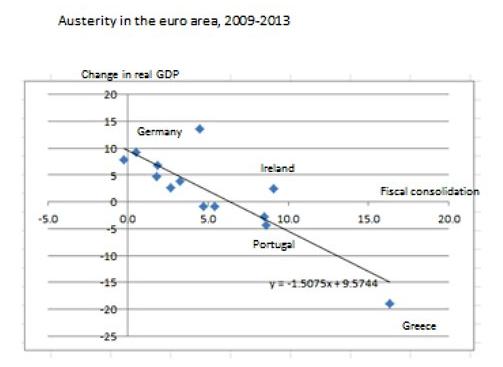
But, you might object, maybe the causation runs the other way; maybe countries in trouble are forced into fiscal consolidation, so it’s not the austerity what did it. But the IMF has an answer to that: it looks at forecast errors versus austerity. Part of the reason for doing this is to figure out why things are going so much worse than expected; but there’s also the fact that the forecasts already included the known problems of the economies in question, so that you’re more or less getting an estimate of the impact of austerity over and above the known problems (and the initially assumed effect of austerity, which was supposed to be small).
As Krugman notes, the key game changing finding from the IMF report is that activity over the past few years has disappointed more in economies which were implementing aggressive fiscal consolidation plans than those that weren’t. Which means the contractionary effects of fiscal consolidation are substantially bigger than policy makers were assuming.
The question is, what will the political elite do with this knowledge? Also, to what degree will the IMF have to stage a “we’re sorry” campaign?
Lastly, if we do all agree that more fiscal stimulus is needed, how do we ensure that stimulus is correctly distributed — and by that we mean to industries of tomorrow rather than to flailing industries of the past?
Related links:
It’s (austerity) Multiplier Failure – FT Alphaville
Let go of the brakes - Free Exchange
The IMF and the GOP - New York Times
Posts: 890
Threads: 95
Joined: Dec 2011
Reputation:
117
10-12-2012, 11:41 PM
(This post was last modified: 10-12-2012, 11:43 PM by Petrovale.)
We need a new Vaticanum to precede the next Great Debate...
Our lack of historical conscience is stupendous to say the least.
Let's phone Witteveen, Rhodes, Guenther, Preston or Kuczynski.
And solve this dam'n thing.
Heck, why hold elections?
Posts: 12,025
Threads: 1,809
Joined: Apr 2008
Reputation:
227
Gauging the multiplier: Lessons from history
Barry Eichengreen, Kevin H O’Rourke, 23 October 2012
http://www.voxeu.org/article/gauging-mul...ns-history
The size of the fiscal policy multiplier – and thus the impact of austerity on GDP – has been a contentious issue since the crisis started. The IMF recently revived the debate by suggesting that the multiplier is much higher than previously thought in the current policy environment. This column discusses independent empirical research that confirms the IMF’s view – the authors’ estimate of the multiplier is in the range of 1.6.
The IMF grabbed headlines and upset officials earlier this month when it released an analysis which concluded that, starting in 2009, the fiscal policy multiplier has actually been considerably larger than previously supposed (IMF 2012). The Fund’s new estimates, which range from 0.9 to 1.7, suggest that Europe’s policies of austerity are in fact directly responsible for the fact that the continent’s recessions have been even deeper than initially forecast.
We are shocked – shocked – to find that there’s multiplication going on in here.
Actually, not so shocked. This is of course just what standard theory would suggest: that the fiscal multiplier will be unusually large when there is little monetary response to the fiscal impulse, whether because interest rates are at the zero lower bound or for other reasons. One might object that the ECB has, in fact, reacted to the Eurozone slowdown by easing. To this we would respond: not so much. What matters in this context are not targeted interventions like last year’s Long-Term Refinancing Operations or this (or next?) year’s Outright Monetary Transactions, which are designed to enhance the operation of particular markets and help specific sovereigns. What matters for the multiplier are economy-wide measures like interest rate cuts and quantitative easing. To date, the latter has been non-existent, while the former have been underwhelming.
The problem is that standard theory doesn’t tell us much about the precise magnitude of the multiplier under such conditions. The IMF’s analysis, moreover, relies on observations for only a handful of national experiences. It is limited to the post-2009 period. And it has been criticised for its sensitivity to the inclusion of influential outliers.
Fortunately, history provides more evidence on the relevant magnitudes. In a paper written together with Miguel Almunia, Agustin Bénétrix and Gisela Rua, we considered the experience of 27 countries in the 1930s, the last time when interest rates were at or near the zero lower bound, and when post-2009-like monetary conditions therefore applied (Almunia et al. 2010).
Our results depart from the earlier historical literature. Generalising from the experience of the US it is frequently said, echoing E Cary Brown, that fiscal policy didn’t work in the 1930s because it wasn’t tried. In fact it was tried, in Japan, Italy, and Germany, for rearmament- and military-related reasons, and even in the US, where a Veterans’ Bonus amounting to 2% of GDP was paid out in 1936. Fiscal policy could have been used more actively, as Keynes was later to lament, but there was at least enough variation across countries and over time to permit systematic quantitative analysis of its effects.
We analyse the size of fiscal multipliers in several ways. First, we estimate panel vector regressions, relying on recursive ordering to identify shocks and using defence spending as our fiscal policy variable. The idea is that levels of defence spending are typically chosen for reasons unrelated to the current state of the economy, so defence spending can thus be placed before output in the recursive ordering. We also let interest rates and government revenues respond to output fluctuations. We find defence-spending multipliers in this 1930s setting as large as 2.5 on impact and 1.2 after the initial year.
Second, we estimate the response of output to government spending using a panel of annual data and defence spending as an instrument for the fiscal stance.
Here too we control for the level of interest rates, although these were low virtually everywhere, reflecting the prevalence of economic slack and ongoing deflation. Using this approach, our estimate of the multiplier is 1.6 when evaluated at the median values of the independent variables.
These estimates based on 1930s data are at the higher end of those in the literature, consistent with the idea that the multiplier will be greater when interest rates do not respond to the fiscal impulse, whether because they are at the lower bound or for other reasons. The 1930s experience thus suggests that the IMF’s new estimates are, if anything, on the conservative side.
In the classic movie Casablanca, Captain Renault expressed shock when publicly describing an uncomfortable fact of which he was privately aware. We suspect that European officials, while also expressing shock and outrage over the IMF’s uncomfortable finding, were similarly aware of what was going on 'in here' well before the Fund brought it to the world’s attention. The question now is whether, having been forced to go public, they are finally prepared to translate that awareness into action.
References
Almunia, Miguel, Agustin Benetrix, Barry Eichengreen, Kevin O’Rourke and Gisela Rua (2010), “From Great Depression to Great Credit Crisis: Similarities, Differences and Lessons,” Economic Policy 25.
Brown, E Cary (1956), “Fiscal Policy in the 1930s: A Reappraisal,” American Economic Review 46:857-879.
Hausman, Joshua (1936), “Fiscal Policy and Economic Recovery: The Case of the 1936 Veterans’ Bonus”, unpublished manuscript, University of California, Berkeley (October).
IMF (2012). World Economic Outlook, Coping with High Debt and Sluggish Growth, October.
|



