Posts: 12,025
Threads: 1,809
Joined: Apr 2008
Reputation:
227
It was only two years ago that Elroy Holtmann spent about $20,000 on a home solar array to help cover the costs of charging his new electric car. With the savings on his monthly electric bills, he figured the investment would pay for itself in about a dozen years. But then the utilities regulators changed the equation. As a result, Pacific Gas & Electric recently did away with the rate schedule chosen by Mr. Holtmann, a retired electrical engineer, and many other solar customers in this part of California. The new schedule will make them pay much more for the electricity they draw from the grid in the evening, while paying those customers less for the excess power their solar panels send back to the grid on sunny summer days.
Why Home Solar Panels No Longer Pay in Some States - The New York Times
While the country has plenty of generation overall -- something like 270 gigawatts of capacity in a system that typically peaks around 180 gigawatts -- local distribution utilities can’t always afford to pay for power from state-owned or private generators. The unreliability of the power system has led to customers building their own shadow utility system, almost as big as the official one.
Can India Really Build 100 Gigawatts of Solar? | Greentech Media
Posts: 12,025
Threads: 1,809
Joined: Apr 2008
Reputation:
227
China has installed 20 gigawatts of new solar power just in the first half of this year. This achievement beats analysts’ expectations by a wide margin. China wants to add 20 GW of new solar every year for the next four, but apparently could do twice that. At the end of 2015, China had about 40 gigawatts of installed solar power, so in just six months it has added half as much again. It already surpasses the previous solar champ, Germany.
6 Signs The Big Global Switch To Solar Has Already Begun | OilPrice.com
The Crescent Dunes “concentrating solar power” plant in Nevada, operated by a Santa Monica firm, is using molten salt as a battery so that it can generate electricity 24/7. It is the first such plant to use solar energy to melt the salt directly instead of via oil, which is a huge advance in efficiency. All electricity plants are just a way to turn turbines using boiling water. If you can turn the turbines with molten salt heated hours ago by the sun, then you can make electricity all day and all night. The Crescent Dunes plant can power 75,000 homes. All those critics of solar power who maintain that it needs gas or nuclear for baseload generation when it is dark or very overcast can now find some other talking point. Solar can do it all. Concentrating solar power costs as little as 10 cents a kilowatt hour, making it competitive with nuclear both in cost and in non-intermittency. Photovoltaic cells plus battery storage may ultimately be cheaper but this means that at the very least we have a relatively inexpensive solar technology that isn’t intermittent.
6 Signs The Big Global Switch To Solar Has Already Begun | OilPrice.com
The Philippines's transformation into a unlikely regional powerhouse in renewable energy hasn't been easy. Juan Miguel Zubiri, a Philippine senator who authored the Renewable Energy Act of 2008, laughingly describes how the Bureau of Internal Revenue wanted to pick a fight with him when the Act was passed because of its generous incentives. These included an income tax holiday for the first seven-years of commercial operations, low corporate tax of 10 percent for the subsequent 25 years, duty-free import of machinery and zero value added tax (VAT).
The Philippines’ renewable energy sector is booming (and it could get bigger)
Posts: 12,025
Threads: 1,809
Joined: Apr 2008
Reputation:
227
Chile has just contracted for the cheapest unsubsidized power plant in the world, Bloomberg New Energy Finance (BNEF) reports. In last week’s energy auction, Chile accepted a bid from Spanish developer Solarpack Corp. Tecnologica for 120 megawatts of solar at the stunning price of $29.10 per megawatt-hour (2.91 cents per kilowatt-hour or kwh). This beats the 2.99 cents/kwh bid Dubai received recently for 800 megawatts. For context, the average residential price for electricity in the United States is 12 cents per kilowatt-hour.
Solar Delivers Cheapest Electricity ‘Ever, Anywhere, By Any Technology’ — ThinkProgress
Posts: 12,025
Threads: 1,809
Joined: Apr 2008
Reputation:
227
But bulls in the solar space continue to point to the long-term trends. The Solar Energy Industries Association calculated that from 2005 to 2015, yearly solar installations in the U.S. have seen an annual compound growth rate of about 60%. Furthermore, the trade group points out that the cost of installing solar has plummeted 70% in the last 10 years... If you want to see the bearish case against solar stocks in real time, look no further than the recent SunPower earnings report. The company previously had forecast $50 million in annual profits, but it now expects a significant loss of $175 million this year instead. To top it off, executives expect SunPower to lose as much as $200 million in fiscal 2017.
Why the clouds will eventually part for solar stocks - MarketWatch
Al Gore believes we are in a turning point in the fight against climate change. The latest version of his “Inconvenient Truth” slideshow, which helped win him a Nobel Peace Prize and an Academy award, is chock-full of charts, factoids, and quotes on the unprecedented revolution in clean energy technologies. As part of his exclusive interview with me earlier this month, Gore spoke about the stunning advances in energy efficiency, renewable energy, and batteries: “It is now clear that the sustainability revolution is more significant in the global economy than the industrial revolution and information revolution combined,” Gore said with more optimism than I’ve ever heard.
Al Gore: The Clean Energy Revolution Is ‘A Dramatic New Reality’ – ThinkProgress
Posts: 12,025
Threads: 1,809
Joined: Apr 2008
Reputation:
227
09-18-2016, 09:37 PM
(This post was last modified: 09-18-2016, 09:47 PM by admin.)
The U.S.'s solar power capacity continues to grow after more than two gigawatts (GW) of solar photovoltaic (PV) installations took place during the second quarter of 2016, according to a report released on Monday. The latest U.S. Solar Market Insight Report from GTM Research and the Solar Energy Industries Association (SEIA) stated that the installations represented a 43 per cent increase compared to the second quarter of 2015.
Big increase for US solar in 2016: Report
At the third minute, Rampell weighs in on whether clean energy jobs would really help laid-off manufacturing workers. At 4:30, Carney shows his complete ignorance and claims that clean energy jobs are “science fiction."
I know that Marketplace knows better. Scott Tong does excellent clean energy reporting for the show on a regular basis.
Let's set the record straight, since Rampell and Carney apparently couldn’t be bothered to perform a basic Google search before the show.
The solar industry alone has created one out of every 80 jobs in the United States since the Great Recession. When including wind, LED lighting, and other clean energy categories, that number could be close to one in 33.
For the solar industry, a majority of these new employment opportunities are blue-collar construction and manufacturing jobs that pay an average of $21 per hour -- far higher than the $16 per hour non-union manufacturing jobs that South Carolina was touting later in that episode.
Clean Energy Jobs Are Exploding in America. Why Don’t Mainstream Reporters Know? | Greentech Media
In fact, the solar industry has hired more veterans than anyone else, retrained coal workers, and even provided a soft landing for oil and gas workers who have lost their jobs. The vast majority of solar and wind workers are trained in less than six months because their previous work experience and training is completely transferrable.
Clean Energy Jobs Are Exploding in America. Why Don’t Mainstream Reporters Know? | Greentech Media
But there's a lot of uncertainty surrounding 2017, and that may already be spreading its way into results from Chinese manufacturers Trina Solar, Renesola, Hanwha Q-Cells, and Yingli Green Energy. These panel manufacturers have more exposure to the spot market for solar panels than U.S. rivals, which could lead to rough results the rest of this year and into next year.
Profitable solar manufacturers could go south quickly - Business Insider
Posts: 12,025
Threads: 1,809
Joined: Apr 2008
Reputation:
227
The Indian government has rightly made rooftop solar power one of its top clean energy priorities -- here’s how the country can jump-start the nascent market. With a bold goal of delivering 100 gigawatts of solar power by 2022, India is helping to create one of the world’s fastest-growing solar markets. Impressive progress has been made toward building out the 60 gigawatts of utility-scale solar necessary to make good on the goal. However, the remaining 40 gigawatts of rooftop solar need a boost. Getting this market right can help put a serious dent in the energy poverty suffered by 80 million households currently lacking electricity, and it is critical for supporting the country's growing middle class.
India Wants to Install 40GW of Rooftop Solar by 2022—Here’s What It Will Take to Hit That Goal | Greentech Media
As China adds record amounts of renewable energy, a solar farm under construction in the Ningxia region of the country’s northwest takes efforts to a new level. The project, being developed in phases by the clean energy unit of China’s biggest private investment group, will cover 4,607 hectares, or slightly more than 7,000 U.S. east coast city blocks. It will boast capacity of 2 gigawatts when complete, surpassing the scale of photovoltaics in place in Thailand at the end of 2015. The 15.6 billion-yuan ($2.34 billion) plant will need about 6 million panels and will be the biggest the world has ever seen.
Out of China’s Dusty Northwest Corner, a Solar Behemoth Arises - Bloomberg
For those of us who have grown weary of each new month setting a "hottest-ever" record, here’s a more encouraging monthly trend. For each month this year, renewable energy production in the U.S. has exceeded the same months in all previous years, according to the U.S. Energy Information Administration. That achievement is particularly notable because it happened in spite of below-average hydroelectric output caused by drought along the West Coast.
US Renewable Electricity Production Beat Previous Years for Each Month in 2016 | Greentech Media
Posts: 12,025
Threads: 1,809
Joined: Apr 2008
Reputation:
227
This week saw the lowest-ever bid for electricity from a proposed solar plant, worldwide. A proposed development in Abu Dhabi will sell its electricity for 2.42 cents a kilowatt-hour (kWh). The bid answered a request for proposals from the state electric company for a 350-megawatt (MW) solar plant. For context, the average price per kWh for residential electricity in the United States — from all sources — is 12.73 cents. Wholesale prices for electricity can vary dramatically, but a set of record-low bids last summer for solar in Austin were around 4 cents per kWh. A 350 MW plant provides enough electricity to power about 57,000 average U.S. homes.
Solar just hit its lowest price ever
According to Lawrence Berkeley's wind analysis, over 8GW of capacity were installed, bringing the US' cumulative capacity to nearly 75GW. That still trails China's capacity, which is nearly double that. But, because the US has such excellent resources, it generates more electricity through wind than any other country; wind now accounts for over five percent of the total electricity generated in the states.
US renewables: Dropping in price, growing in significance | Ars Technica
Posts: 2,904
Threads: 58
Joined: Mar 2012
Reputation:
259
Admin -
With interests much diminishing in Interoil I hope this resource regarding solar you are providing will. This is an excellent newsfeed forum that deserves attention. Perhaps the addition of a hydrocarbon forum would be an appropriate alternative to IOC for those of us that lost a dream yesterday yet still believe NG is an important bridge fuel. Several have already expressed similar interests I know. Just adding my name to the list.
Posts: 12,025
Threads: 1,809
Joined: Apr 2008
Reputation:
227
'ArtM72' pid='76488' datel Wrote:Admin - With interests much diminishing in Interoil I hope this resource regarding solar you are providing will. This is an excellent newsfeed forum that deserves attention. Perhaps the addition of a hydrocarbon forum would be an appropriate alternative to IOC for those of us that lost a dream yesterday yet still believe NG is an important bridge fuel. Several have already expressed similar interests I know. Just adding my name to the list.
Yes, thanks, I'll try to keep it up
Posts: 12,025
Threads: 1,809
Joined: Apr 2008
Reputation:
227
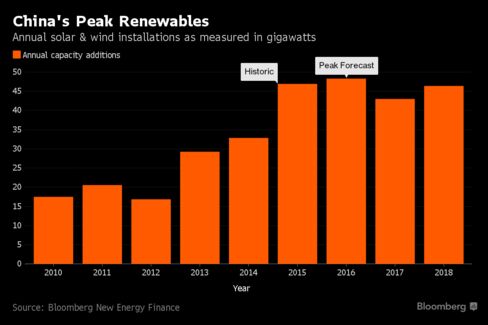
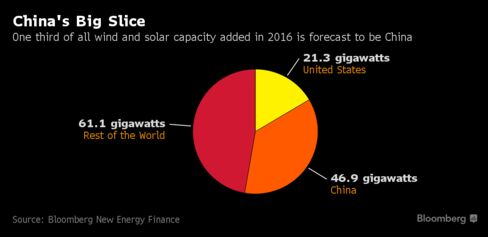
After installing more wind and solar farms than anywhere else on the planet, China is ratcheting back the pace of growth in an industry that’s helped lower the costs of green energy worldwide. Installations of new wind and solar farms in China are expected to drop 11 percent in 2017 from a record high this year, according to Bloomberg New Energy Finance. That would be the first decline in the history of the modern renewables business, now a little more than a decade old, for a nation that has provided about a third the investment for the industry.
China to Slow Green Growth for First Time After Record Boom - Bloomberg
Still, it doesn't like a complete disaster..
|