
Thread Rating:
  • 0 Vote(s) - 0 Average
  • 1
  • 2
  • 3
  • 4
  • 5
Secular stagnation
#1


How to escape from the slow-growth doldrums


More than six years after the Great Recession's end, economic growth in the U.S. remains lackluster. That's raising concerns among economists that the U.S. is entering a period known as "secular stagnation," an idea first proposed by Alvin Hansen in 1938 and recently revived by Larry Summers.

When an economy enters such a period, it's caught in an extended period of low economic growth. Summers believes the U.S. and other economies may be suffering from this ailment, though it's too soon to know for sure.

To understand the nature and cause of secular stagnation -- and solutions to it -- a simple example might help.

Imagine an economy with no imports and exports, perhaps an isolated island with no way of trading with other islands that produces $100,000 in goods and services each month. One of the most basic concepts in macroeconomics is that the total value of income equals the total value of production, so in this economy the total income of the residents would also be $100,000.

That's because when a good is produced and sold, the income the firm receives is paid out in wages, interest and rent, and whatever is left over is profit (which could be negative). Thus, the value of the good that is sold turns into income of some type.

When goods are held in inventory, things get a bit more complicated, though the result is the same. So, we'll assume no inventories to keep things simple.

Now suppose the island's residents spend $90,000 of their income on goods and services, and save $10,000. Wouldn't that create a problem? There's $100,000 worth of goods and services available in the economy, but only $90,000 in spending. How do the rest of the goods get purchased?

The answer is that $10,000 in saving gets turned into investments through financial markets. This is one of the main functions of financial markets: to find a way to turn saving into productive investments.

Let's assume in this economy, there's $5,000 in deprecation each month, so $5,000 of the $10,000 in saving is used to replace worn out capital, and the other $5,000 is used to purchase new capital that can be used to produce even more in goods and services. Again, to make it simple, assume that the $5,000 in new capital will increase output in the next period by $5,000.

Thus, in the next month, GDP for this economy would increase to $105,000 (a 5 percent growth rate), and the process would repeat. Part of the $105,000 in income will be used for consumption, and the rest will be saved. Financial markets will turn the saving into investment, which covers depreciation from the last period and new investment in the current period. The new investment allows the economy to produce even more, and so on, and so on.

But what if something goes wrong? What if financial markets fail to turn all of the saving into investment?

Let's start with the first month once again, which has $100,000 in income, $90,000 in spending and $10,000 in saving. Suppose something goes wrong so that only $5,000 is turned into investment -- just enough to cover depreciation, but not enough for any new investment -- and the other $5,000 sits idly in banks as excess reserves.

In this case, with no new capital, there would be no growth. So, in the next period, production and income would be $100,000 once again.

The failure of financial markets to turn all of the saving into investment results in zero percent growth instead of the 5 percent growth realized when all of the saving was utilized.

If less than $5,000 of the $10,000 is turned into investment, the economy can't even cover depreciation, and growth would be negative. If more than $5,000 is utilized, but less than $10,000, there would be some growth, but it would be less than 5 percent.

If this continues period after period, it becomes an instance of secular stagnation.

Classical economists did not believe this could happen. They argued that financial markets would always find a way to equate saving and investment.

The key is movement in the interest rate. Interest is the reward for saving. When interest rates rise, people tend to save more. However, interest is also the cost of borrowing the funds needed to make an investment, and when interest rates go up investment tends to fall (borrowing costs are higher, so fewer projects are expected to be profitable).

Saving and investment are equated through market forces that move the interest rate up and down. For example, if saving is less than investment, interest rates will tend to increase, causing saving to rise and investment to fall until both are equal. In the opposite case, interest rates will decrease until saving and investment are aligned.

The essence of this argument is no different than the usual supply-and-demand models. If supply is greater than demand, prices fall; if supply is less than demand, prices rise and bring the market back into equilibrium. Just think of the interest rate as the price of money.

There is no practical limit to how much interest rates can increase, but they can fall only so far. The "zero lower bound" (ZLB) constrains how low interest rates can go (if they're negative, you can borrow money, then pay back less than you borrowed -- but why would a lender want to do this?). I'm omitting some technical points: The bound isn't exactly zero, and the Fed has ways to produce negative interest rates, but it hasn't been willing to do that, so the ZLB has been an effective constraint.

The following two diagrams illustrate the secular stagnation problem. Both show how saving (S) and investment (I) change with the interest rate ®, as just described, and the intersection of the two lines is the equilibrium point. The first diagram shows normal times:
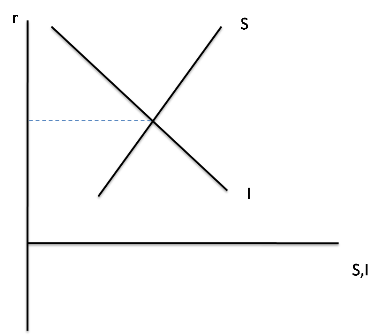


In this case, the classical argument is correct: Market forces will push the interest rate to the point where saving and investment are the same (think of this as the $10,000 in saving being turned into investment in the first example above).

But in a recession, the investment curve shifts inward as businesses foresee poor economic conditions ahead and invest less at every interest rate. In a big recession, like the one we just had, it's possible for the investment curve to shift inward by a large amount, so large that the equilibrium interest rate is negative:
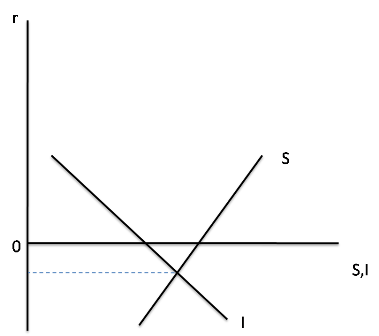


In this case, the interest cannot fall enough to equate saving and investment because it's limited by the ZLB. When the interest rate falls to zero and gets stuck there, saving will be greater than investment (on our island, this is the case where saving is $10,000, but investment is less than that). So long as the economy is stuck in this trap, it will experience stagnant growth. Investment and growth would be higher if the economy could somehow reach the equilibrium point.

What's the solution to this problem? There are two ways the equilibrium could be returned to a positive interest rate. The first is to shift the saving function inward. If policy could cause this to happen -- a tax on saving perhaps -- it would work, but in this case investment would fall even further. A better solution would be to shift the investment function outward.

How can this be accomplished? Investment is the sum of private sector investment plus public sector (government) investment. Private investment could be increased by lowering the interest rate with monetary policy, but since the interest rate is as low as it can go, this won't be effective.

Another solution is to raise private investment through mechanisms such as tax incentives. But in a stagnating economy, business confidence is low, and it's unlikely this will have much of an effect. It's worth trying, but it's unlikely to be enough.

Yet another solution is to raise public investment; infrastructure spending is a frequently mentioned candidate. This is attractive for two reasons. First,investment in U.S. infrastructure has been lagging, which needs to be addressed independent of the secular stagnation problem. Second, while tax incentives amount to leading a horse to water and hoping it will drink, government investment is determined by fiscal policy. It can be whatever value Congress and the president want it to be.

This is why those who are worried about secular stagnation have repeatedly called for substantial investment in infrastructure.

To repeat, we do not yet know if the U.S. in a secular stagnation episode. But if it is, the time to act is now. The longer we wait, the harder it will be to overcome. Since the country needs infrastructure spending in any case, why not use it as insurance against this possibility?

Reply

#2
Lower rates are not just the result of central banks buying billions of dollars worth of bonds over the years in the United States, Europe, and Japan, according to Brian Barnier, head of research at ValueBridge Partners and founder of FedDashboard.com. “There’s more cash in the world and less need for cash in production,” he said. Relative to disposable personal income, household and nonprofit cash holdings are up since the 1990s. But in the past decade, debt’s share of personal income has steadily decreased.

Why rates could stay low no matter what the Fed does

But how much do we really know? The president of the Federal Reserve Bank of San Francisco, John Williams, set the tone for the gathering of central bankers at Jackson Hole, Wyo., last month when he published a widely read letter suggesting the long-run “natural” rate of interest has come down drastically in the past 25 years. This is the rate that would keep inflation steady if the economy were operating at full capacity, and provides the basis for where rates ought eventually to stabilize. His letter was backed by an updated version of a model he first published more than a decade ago, with two Fed colleagues,  Kathryn Holston and Thomas Laubach. The model shows the long-run interest rate has come down not only in the U.S. but also in the eurozone, Canada and the U.K. Secular stagnation has taken hold of the developed world, as one of their charts shows.

Think You Know the Natural Rate of Interest? Think Again - Real Time Economics - WSJ

Reply

#3
One of the biggest spots was the global imbalance of current accounts, according to HSBC Chief Economist Janet Henry. The imbalance from a world where some countries were hoarding and others were spending too freely led to malinvestment and ultimately bubbles, according to Henry. The worrying issue that faces the world now, Henry said in a note to clients, is that these imbalances are growing once again. "Just under a decade ago, the global savings glut was widely blamed for the misallocation of resources that led to bubbles, busts and ultimately the global financial crisis," wrote Henry. "The fact that global imbalances widened again in 2015 and that in dollar terms they will be close to record highs this year poses risks for both debtor and creditor countries."

Current account 'global imbalances' financial crisis growing again - Business Insider

These surpluses have built up to nearly historic levels for a few reasons, said Henry. Weak internal demand in countries with current-account surpluses means those countries' citizens are under-consuming and thus saving too much money. Additionally, the savings are being invested outside of the country. "Running persistent current account surpluses implies that these economies are constantly saving more than they are investing, preferring to invest those savings overseas," said Henry in the note. "In other words, they are building up a large net international investment position: something countries with aging populations (including Japan, Germany, China and South Korea) can argue is necessary to sustain living standards."

Current account 'global imbalances' financial crisis growing again - Business Insider

Reply

#4
Over time, low-productivity sectors have become a larger share of the economy, while high-productivity goods production has become a smaller share. And an economy dominated by industries with low productivity growth is going to grow slowly.

The productivity paradox: why we're getting more innovation but less growth - Vox

This week the White House proposed a new plan to increase labor market competition and wage growth in the United States — one that prominently featured a call to state governments to rein in "noncompete agreements." These arrangements — far more widespread than most people think — prohibit employees from leaving to join or start firms within the same industry as their existing employer. By reducing barriers to employee mobility and entrepreneurship, the White House seeks to both help firms hire the best workers they can and give individuals the ability to move to the job that is best for them.

A new White House proposal targets a hidden culprit holding down Americans' pay - Vox

What the two economists find is that the efficiency gains that were supposed to appear didn’t in fact happen. This study found that increased consolidation doesn’t have any significant effect on plant-level productivity. What it does have an effect on is prices (and profits): markups increased due to the consolidation of manufacturing firms. The increase in markups appears quite significant: 15 percent to 50 percent of the average markup in the data. In other words, the price of manufactured goods increased while there were no productivity gains. The increasing amount of rents in the manufacturing sector could very well have contributed to higher income inequality, either intrafirm or interfirm, depending on how the gains were shared within the company.

New research on market power and productivity - Equitable Growth

It seems that the Federal Reserve is starting to recognise that the decline in the equilibrium interest rate in the US (r*) has been driven not by temporary economic “headwinds” that will reverse quickly over the next few years, but instead has been caused by longer term factors, including demographic change. Because these demographic forces are unlikely to reverse direction very rapidly, the conclusion is that equilibrium and actual interest rates will stay lower for longer than the Fed has previously recognised. Of course, the market has already reached this conclusion, but it is important that the Fed is no longer fighting the market to anything like the same extent as it did in 2014-15. This considerably reduces the risk of a sudden hawkish shift in Fed policy settings in coming years.

It’s the demography, stupid!

It seems like the United States economy is enjoying more innovation than ever before. At the same time, statistics show the economy suffering from its slowest growth in decades. Analysts often try to resolve this by arguing either that conventional statistics aren’t properly measuring the value of innovation or else that the apparent speed-up in innovation is actually an illusion and progress is slowing down. Another possibility is that things are exactly as they seem: Rapid technological innovation is real, and so is slow economic growth. In fact, in a sense the innovation is causing the slow growth. Call it the productivity paradox, and recognize that it explains a lot about the current state and the future direction of the American economy.

The productivity paradox: why we're getting more innovation but less growth - Vox

Reply

#5
But the troubling reality is that today’s advances are having a far from impressive impact on overall economic growth. Facebook, Twitter, and other digital technologies undoubtedly bring great value to many people, but those benefits are not translating into a substantial economic boost. If you think Silicon Valley is going to fuel growing prosperity, you are likely to be disappointed—or you’d better be patient. While the high-tech industry creates impressive wealth for itself, much of the country is mired in a sluggish economy.

Dear Silicon Valley: Forget Flying Cars, Give Us Economic Growth

Michael Mandel, an economist at the Progressive Policy Institute in Washington, D.C., says the productivity slowdown is occurring in what he calls the physical industries, including manufacturing and health care. Such industries, which he estimates make up 80 percent of the national economy, account for only 35 percent of investments in information technology and their productivity reflects that, growing at only 0.9 percent annually. Meanwhile, productivity is growing by 2.8 percent a year in what Mandel calls digital industries, which include finance and business services.

Dear Silicon Valley: Forget Flying Cars, Give Us Economic Growth

Reply

#6
But the study goes a giant step further, claiming that the very fact that the United States is an aging society weakens economic growth. “The fraction of the United States population age 60 or over will increase by 21 percent between 2010 and 2020,” says the study. This aging shaves 1.2 percentage points off the economy’s present annual growth rate, the study estimates.

Are aging and the economic slowdown linked? - The Washington Post

Reply

#7
We should also consider the possibility that weak demand has played a role in holding back productivity growth, although standard economic textbooks generally trace a path from productivity growth to demand rather than vice versa. Chair Yellen recently spoke on the influence of demand on aggregate supply.3 In her speech, she reviewed a body of literature that suggests that demand conditions can have persistent effects on supply.4 In most of the literature, these effects are thought to occur through hysteresis in labor markets. But there are likely also some channels through which low aggregate demand could affect productivity, perhaps by lowering research-and-development spending or decreasing the pace of firm formation and innovation. I believe that the relationship between productivity growth and the strength of aggregate demand is an area where further research is required.

FRB: Speech--Fischer, Longer-Term Challenges for the U.S. Economy--November 21, 2016

Reply

#8

Inflation still not raising its head, from FT Alphaville

Most importantly, shelter, one of the largest (18% of core PCE) and most stable components of core inflation, has appeared to roll over in recent months. Housing prices have been steadily accelerating since the crisis, but recently, many of the fundamental drivers identified in our shelter inflation model – housing price growth, rental vacancy rates, and mortgage delinquencies – have either peaked or slowed significantly. While we do not expect housing inflation to collapse anytime soon, the consistent boost to core PCE from this category has likely already begun to fade.


Core goods prices have also been soft recently, and while these prices tend to be volatile, there are reasons for concern that this weakness might persist.


Auto prices, in particular, have deteriorated and weak fundamentals in this sector suggest a strong rebound is unlikely. Used auto supply has been steadily increasing, putting downward pressure on prices and new sales. At the same time, auto credit has been tightening amid an uptick in delinquency rates.

Inflation might start rebounding soon, perhaps if economic growth itself proves to have accelerated in the second quarter. But regardless of the implications for monetary policy, it simply isn’t right to say that this year’s weakness is mainly down to big swings in a couple of fringe components.

Reply


Forum Jump:


Users browsing this thread: 1 Guest(s)